Tunisia Orders 18 New Electric Trains to Complete Modernisation of the Tunis–La Goulette–La Marsa Railway
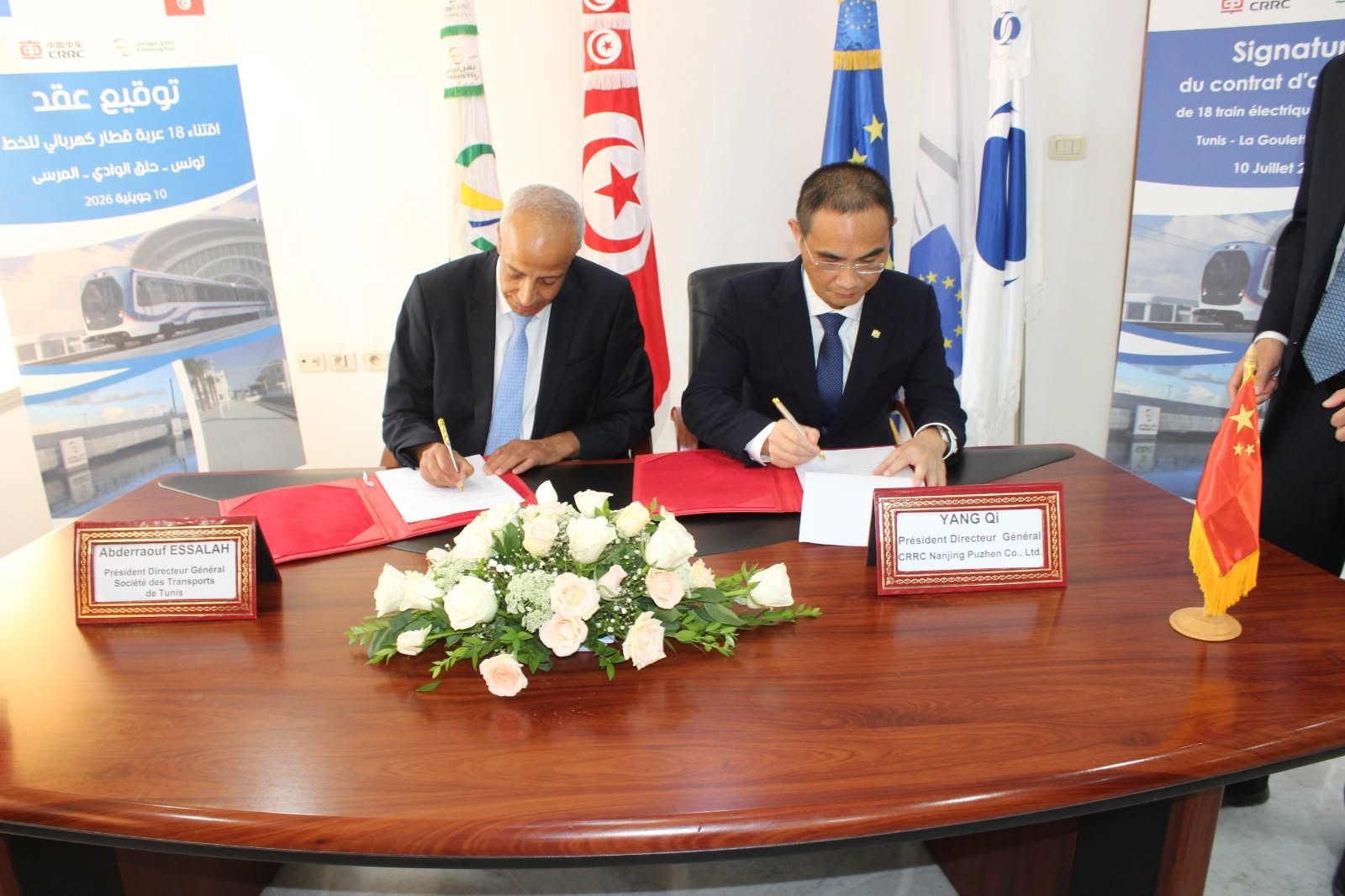
Tunisia’s public transport operator TRANSTU has signed a contract with China’s CRRC Nanjing Puzhen for the supply of 18 new electric trainsets for the Tunis–La Goulette–La Marsa (TGM) railway. Backed by €75 million in financing from the European Bank for Reconstruction and Development (EBRD) and the European Investment Bank (EIB), the project marks the final phase of the historic suburban rail line’s modernisation.
Tunisia is taking another major step towards upgrading its urban rail network with the procurement of 18 new electric multiple units (EMUs) for the Tunis–La Goulette–La Marsa (TGM) suburban railway.
On 10 July 2026, the Société des Transports de Tunis (TRANSTU) signed a contract with CRRC Nanjing Puzhen Co. Ltd. for the supply of the new fleet, alongside a five-year maintenance agreement covering spare parts and technical equipment to ensure the reliability, availability and operational safety of the trains.
The investment forms part of Tunisia’s broader strategy to modernise public transport infrastructure and promote more sustainable urban mobility.
€75 million investment supported by European financial institutions
The project represents a €75 million investment, jointly financed by the European Bank for Reconstruction and Development (EBRD) and the European Investment Bank (EIB), with support from the European Union under its sustainable transport cooperation framework.
The contract signing ceremony was attended by representatives of Tunisia’s Ministries of Transport, Economy and Planning, and Foreign Affairs, alongside officials from the European Union, the EBRD, the EIB and other institutional partners.
Beyond fleet renewal, the project reflects continued international cooperation in financing modern rail infrastructure and improving public transport services in North Africa.
Higher capacity and improved passenger services
Each new electric train will be 40 metres long and capable of carrying 400 passengers, including 90 seated passengers. The trains will feature dedicated spaces for passengers with reduced mobility, onboard CCTV systems and real-time passenger information displays.
Designed to operate at speeds of up to 100 km/h, the new fleet will enable services to run every six minutes during peak hours and every 12 minutes during off-peak periods, significantly improving service frequency and passenger flow while meeting international safety and quality standards.
Completing the modernisation of the historic TGM line
The procurement of the new rolling stock completes a broader modernisation programme that has already upgraded the TGM’s:
- railway tracks;
- passenger stations;
- electrical substations;
- engineering structures;
- signalling systems.
With infrastructure works now completed, the arrival of the new trains will mark the final stage in the transformation of one of Tunisia’s oldest and most iconic suburban railway lines, linking downtown Tunis with the coastal districts of La Goulette and La Marsa.
The first trainsets are expected to be delivered in early 2028.
Why it matters
- Sustainable urban mobility: The new fleet will improve service quality, increase passenger capacity and support the transition towards lower-carbon public transport.
- Rail industry: The contract strengthens CRRC’s presence in Africa’s rail market while highlighting the growing role of international manufacturers in the continent’s railway modernisation programmes.
- Infrastructure finance: The EBRD and the EIB continue to support strategic transport investments that enhance urban mobility, economic productivity and climate resilience across North Africa.
LogistAfrica Insight
Although the TGM is primarily a passenger railway, its modernisation will contribute to the overall efficiency of Greater Tunis’ transport ecosystem. More reliable and higher-capacity urban rail services improve workforce mobility, reduce road congestion and strengthen multimodal connectivity—key factors for enhancing metropolitan logistics performance and economic competitiveness. The project also illustrates the increasing importance of rail investment in Africa’s sustainable transport agenda.