
SAPICS LEADERS FORUM EXPLORES SPEED AS THE NEW COMPETITIVE CURRENCY IN SUPPLY CHAINS
Supply chain industry body SAPICS hosted its prestigious annual Supply Chain Leaders Forum in Sandton, Johannesburg, as part of the Leaderex event. The summit brought together supply chain management leaders to explore the rising value of speed as the new competitive currency in supply chains.
The event’s opening keynote speaker, Francois Retief, explored order to delivery challenges and opportunities in the rapidly growing e-commerce environment. In 2025, South Africa was the fastest growing e-commerce market in the world, according to a report by financial services firm Morgan Stanley. As the CEO of Takealot Fulfilment Solutions, Retief had a wealth of insights to share with attendees at the SAPICS gathering, including the importance of managing order to delivery “fast, with certainty and affordably”. This, he said, is the winning proposition in ecommerce.
Retief stressed the need to plan for peaks like Black Friday and examined the impact of technology like robot sortation. For Takealot Fulfilment Solutions, commissioning a fleet of advanced autonomous sorting robots at its Johannesburg fulfilment centre has streamlined workflows and enhanced daily productivity. Retief explained how the robots take themselves to the “robot hospital” when they need servicing and charge themselves.
In his insightful presentation, Jeremy Basckin from Neways Solutions explained why synchronised, real-time decision-making is replacing traditional planning frameworks in supply chains. Basckin said that many businesses still rely on planning methodologies, systems and dashboards that are static, periodic, functionally siloed and backward-looking. “These tell us what happened, and it is often too late to influence the outcome. To survive and thrive, businesses must make the transition from static to continuous metrics; from periodic to real-time measurements; from functional to synchronised planning and from historical to predictive dashboards. We don’t just need to know how we performed, but what to do next,” he stressed.
Basckin said that business synchronisation is critical. “Product, demand, inventory, supply, production and financial plans cannot operate independently. Every decision made in one area affects service, capacity, inventory, cash, margin and growth across the entire business. The companies that outperform in the next decade won’t be those with the best individual planning process. They’ll be the ones that synchronise the entire business in real time.”
He also advised attendees to “order smaller, more often”. “Shrinking the order interval – not the lead time – is the highest-value fix since up to 75% less cash is tied up in cycle stock, he stated.
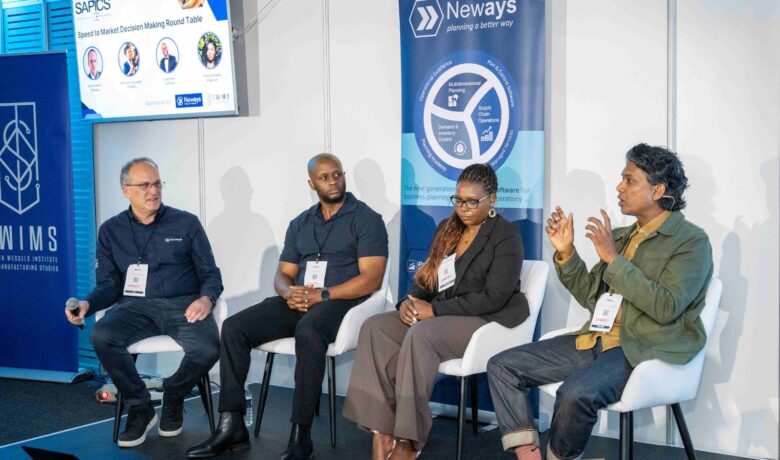
A highlight of the 2026 SAPICS Supply Chain Leaders Forum was a powerful panel discussion that explored speed to market decision making. Contributing to the discussion were panellists Linda Cham, who is a director of SAPICS; Tremely Nogaya, senior manager for Franchise Operations and Supply Chain (Africa) at PepsiCo; and Dr Kruschen Govender, head of Future Manufacturing at the Toyota Wessels Institute for Manufacturing Studies (TWIMS). It was moderated by Jeremy Basckin.
From modern control towers and data-driven decision-making to on-demand deliveries, smaller drop vehicles and scooters, supply chains are being reshaped, the panellists noted. They discussed how stores are increasingly being used as distribution centres, the rise of dark stores, the changing economics of last-mile delivery, the evolving skills and capabilities of supply chain professionals, and Africa’s infrastructure constraints when it comes to speed to market. They examined the critical role of data quality and why supply chains need to move beyond simply responding quickly to responding intelligently.
The annual SAPICS Supply Chain Leaders Forum has become a flagship event, reflecting the organisation’s commitment to developing the supply chain leaders, partnerships, knowledge and skills that are shaping supply chain excellence in Africa.
PHOTO CAPTION:
Jeremy Basckin, Linda Cham, Tremely Nogaya and Dr Kruschen Govender who took part in a powerful panel discussion at the SAPICS Supply Chain Leaders Forum.
For more information:
Email: info@sapics.org.za
ABOUT SAPICS: http://www.sapics.org
Since 1966, SAPICS has worked to elevate, educate and empower the community of supply chain professionals in South Africa and across the continent. This is done via membership, events, the annual conference and education courses and workshops through Authorised Education Providers and others.
SAPICS is registered in South Africa as a not-for-profit company. Its mandate is to ensure that any profits made are used towards the continual development and overall benefit of individuals and organisations in the supply chain management profession.
The annual SAPICS Conference is the leading event in Africa for supply chain professionals and is now in its 48th year. The 2026 SAPICS Conference takes place in Cape Town from 19 to 22 July 2026.