Kenya’s China Tariff Gain Means Little If Exports Keep Failing
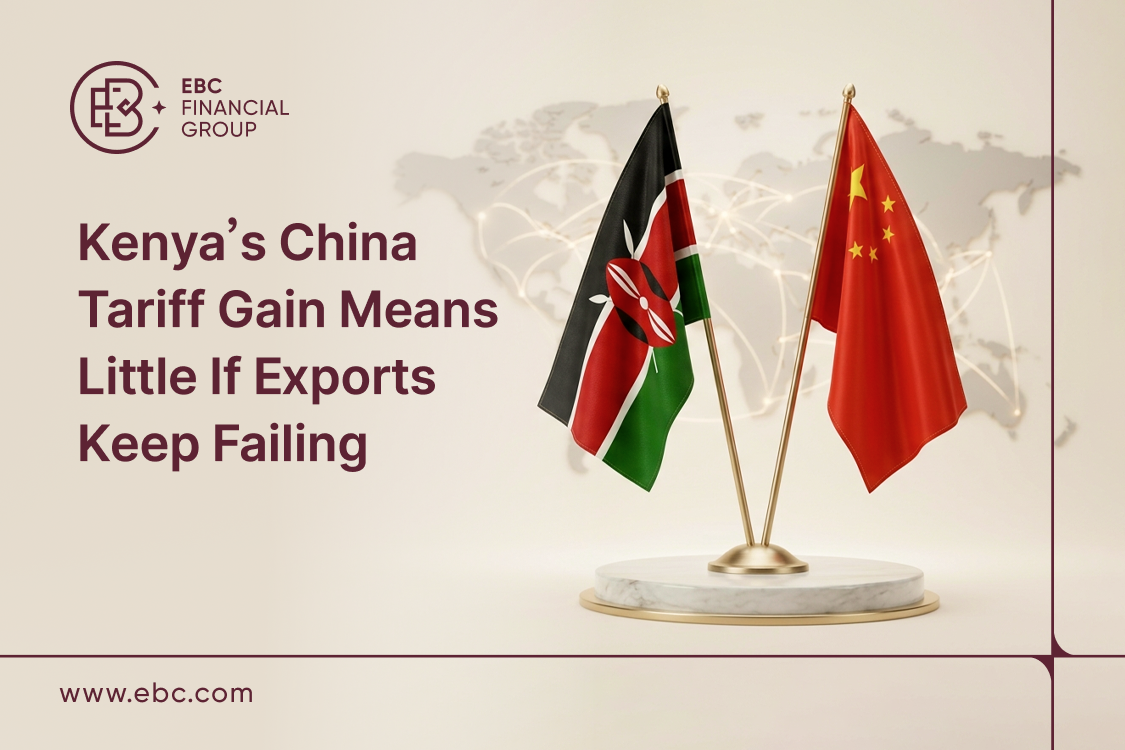
EBC Financial Group (EBC) says duty-free access will mean little if Kenya cannot lift exports from USD 196.56 million, expand processed shipments and start narrowing a trade relationship still dominated by USD4.31 billion of Chinese imports.
NAIROBI, 27 April 2026 — EBC Financial Group (EBC) views Kenya’s China tariff opening as a direct test of whether easier access can arrest a two-year export decline before a wider African rollout reduces any short-term pricing advantage. Official Kenyan trade data puts Kenya’s 2024 exports to China at USD196.56 million and imports from China at USD4.31 billion. Kenya says about 98.2% of its products now qualify for zero-duty entry under the Early Harvest Agreement, while China says it is extending zero-tariff treatment across all African countries with diplomatic relations with Beijing from 1 May 2026. Kenya is therefore entering a wider opening from a weak export base rather than from rising momentum.

David Precious, Senior Markets Analyst at EBC Financial Group, said, “Kenya has secured easier access to China, but easier access does not correct a trade relationship that is already moving towards another direction. Exports to China have been falling, imports remain above USD 4.3 billion, and the same tariff opening is being extended more widely across Africa. That leaves Kenya needing more than a headline concession. It needs export growth that is larger, more regular and more heavily weighted towards processed goods.”
Kenya Enters the Opening with Exports Already Failing
Kenya’s export trend is already moving in the wrong direction. The State Department for Trade says exports to China fell from USD233.84 million in 2022 to USD207.92 million in 2023 and USD196.56 million in 2024, while imports from China stood at USD3.84 billion, USD3.28 billion and USD4.31 billion across the same three years. That leaves the agreement carrying a harder burden than the headline suggests. EBC notes that this does not look like it opens a neutral trade lane, but instead it looks like an attempt to reverse deterioration in a relationship that has continued to tilt towards Chinese goods.
Kenyan officials are already defining the agreement in those terms. The Ministry of Foreign and Diaspora Affairs (MFA) says the bilateral deficit is estimated at more than KES 500 billion, or about USD4 billion, and links the framework to export performance, trade rebalancing and measurable economic outcomes. EBC highlights that market access on paper does not reduce a deficit of that size unless it changes what Kenya sells, how much it sells, and how regularly those shipments reach buyers.
Shared African Access Limits the Value of Tariff Relief on Its Own
China’s wider Africa policy changes the commercial meaning of Kenya’s deal. The same zero-tariff treatment is being extended across African countries with diplomatic ties to Beijing, and China has also said it plans to widen access for African exports through an upgraded green channel and related measures. Kenya is therefore not receiving a Kenya-only pricing edge into the Chinese market. It is entering a broader African contest in which lower duties apply more widely, which places more weight on quality, standards compliance, delivery reliability, traceability and supply consistency.
That point has a practical consequence where a tariff concession shared across most of Africa offers less commercial separation than a Kenya-only concession would. Kenyan exporters may therefore need to compete through speed, product consistency and execution rather than assume lower duties alone can raise market share. Tariff access improves terms of entry. It does not guarantee that Kenyan goods stand out once rival suppliers receive similar treatment.
Processed Goods Look More Capable of Changing the Numbers than Raw Volume Alone
Kenya’s own product mix points to where the more durable opportunity appears to sit. Officials have identified tea, coffee, avocados, macadamia nuts and horticultural products as likely beneficiaries, and the first consignment under the arrangement included fresh avocados, avocado oil, coffee, green beans, hides and skins. Fresh produce may lift shipment counts. Processed goods may do more. They can retain more income inside Kenya through processing, packaging, storage and freight before the goods leave port, and they are less exposed to the thin margins that usually come with raw volume alone.
Based on that, EBC analysts consider processed agricultural exports to the stronger commercial test. More avocado oil rather than only fresh avocados, more processed coffee rather than only lower-value output, and more export-ready horticulture may give Kenya a better chance of defending margins and keeping more of the value chain at home. Raw volume may raise exports without materially shifting the structure of the relationship, because China would still be supplying a far larger volume of higher-value manufactured goods in the other direction.
Capacity Inside Kenya Now Appears More Important than the Tariff Line Itself
Domestic capacity now carries more weight than the tariff cut itself. MFA links the framework to business-to-business linkages, regulatory efficiency, export readiness, trade logistics, agro-processing, and cold-chain investment. That amounts to an official acknowledgement that lower Chinese duties do not create Kenyan processing lines, working capital, quality-control systems or dependable delivery schedules. The main question is no longer whether access exists but whether Kenyan firms can use it repeatedly and at scale.
That distinction is commercial, not rhetorical. Kenya may secure early consignments without building a repeatable export pipeline. A broader shift is more likely to depend on whether firms can fill larger orders, meet Chinese standards consistently and deliver on time. Without those capabilities, easier access may improve visibility without materially improving the economics of the relationship.
Deeper Two-way Opening Raises the Pressure on Kenya to Move Faster
China’s commerce ministry says the Early Harvest Arrangement provides zero-tariff treatment for Kenyan goods while Kenya further opens its market to Chinese products. That narrows Kenya’s room for delay. The country is already running a very wide bilateral deficit, so export gains may need to arrive before deeper two-way opening gives Chinese goods broader reach in a market they already dominate. Timing therefore matters alongside access.
Kenya’s International Monetary Fund Backdrop Increases the Value of Every Export Dollar
Kenya’s external financing backdrop also raises the value of any export gain. The International Monetary Fund (IMF) says Kenya has formally requested a new IMF-supported programme and that preliminary discussions are under way. The IMF also says the 2025 Article IV consultation was rescheduled at the authorities’ request so programme discussions could take priority. In that setting, stronger exports to China may do more than lift bilateral receipts. They may also add hard-currency inflows at a time when Kenya is still trying to reinforce external buffers and macroeconomic credibility.
“The commercial test is now much narrower and much harder,” Precious added. “If Kenya cannot turn this opening into repeat Chinese demand for goods that are processed, standards-compliant and reliable in volume, the agreement may improve access without materially improving the trade balance. If it can, the gains could start to show up not only in export receipts, but in how much value Kenya keeps before those goods leave the country.”
The Next Phase is Measurable in the Trade Data
Based on the current situation, a more credible improvement can show up in a steadier export trend after May. A larger share of processed goods in China-bound shipments, stronger investment in agro-processing and cold-chain capacity, and a narrower bilateral gap over time are the indicators that can show whether the agreement changes the structure of the relationship or simply improves the terms of an imbalance that remains wide.
For more information, visit www.ebc.com.
###
Disclaimer: This material is for information only and does not constitute a recommendation or advice from EBC Financial Group and all its entities (“EBC”). Trading Forex and Contracts for Difference (CFDs) on margin carries a high level of risk and may not be suitable for all investors. Losses can exceed your deposits. Before trading, you should carefully consider your trading objectives, level of experience, and risk appetite, and consult an independent financial advisor if necessary. Statistics or past investment performance are not a guarantee of future performance. EBC is not liable for any damages arising from reliance on this information.
About EBC Financial Group
Founded in London’s esteemed financial district, EBC Financial Group (EBC) is a global brand known for its expertise in financial brokerage and asset management. Through its regulated entities operating across major financial jurisdictions—including the UK, Australia, the Cayman Islands, Mauritius, and others—EBC enables retail, professional, and institutional investors to access a wide range of global markets and trading opportunities, including currencies, commodities, shares, and indices.
Recognised with multiple awards, EBC is committed to upholding ethical standards and these subsidiaries are licensed and regulated within their respective jurisdictions. EBC Financial Group (UK) Limited is regulated by the UK’s Financial Conduct Authority (FCA); EBC Financial Group (Cayman) Limited is regulated by the Cayman Islands Monetary Authority (CIMA); EBC Financial Group (Australia) Pty Ltd, and EBC Asset Management Pty Ltd are regulated by Australia’s Securities and Investments Commission (ASIC); EBC Financial (MU) Ltd is authorised and regulated by the Financial Services Commission Mauritius (FSC); EBC Financial Group SA (Pty) Ltd is authorised and regulated by the Financial Sector Conduct Authority (FSCA).
At the core of EBC are a team of industry veterans with over 40 years of experience in major financial institutions. Having navigated key economic cycles from the Plaza Accord and 2015 Swiss franc crisis to the market upheavals of the COVID-19 pandemic. We foster a culture where integrity, respect, and client asset security are paramount, ensuring that every investor relationship is handled with the utmost seriousness it deserves.
As the Official Foreign Exchange Partner of FC Barcelona, EBC provides specialised services across Asia, LATAM, the Middle East, Africa, and Oceania. Through its partnership with United to Beat Malaria, the company contributes to global health initiatives. EBC also supports the ‘What Economists Really Do’ public engagement series by Oxford University’s Department of Economics, helping to demystify economics and its application to major societal challenges, fostering greater public understanding and dialogue.