Successful Rail Trial: the Béchar–Tindouf–Gara Djebilet Line, a New Pillar of Mining Logistics and Supply Chain in Algeria
By the editorial team of Logis-T Africa
The successful completion of the technical trials of the Béchar–Tindouf–Gara Djebilet railway line, announced on Wednesday by the National Agency for Studies and Monitoring of Railway Investment Projects (ANESRIF), marks a pivotal moment for logistics in Algeria and, more broadly, for mining logistics in North Africa. Tested along its entire 950-km route across the south-western desert, this strategic infrastructure now confirms its role as the backbone of the supply chain in Algeria, serving industrialisation, mass transport, and regional and international trade.
A conclusive trial securing mining transport
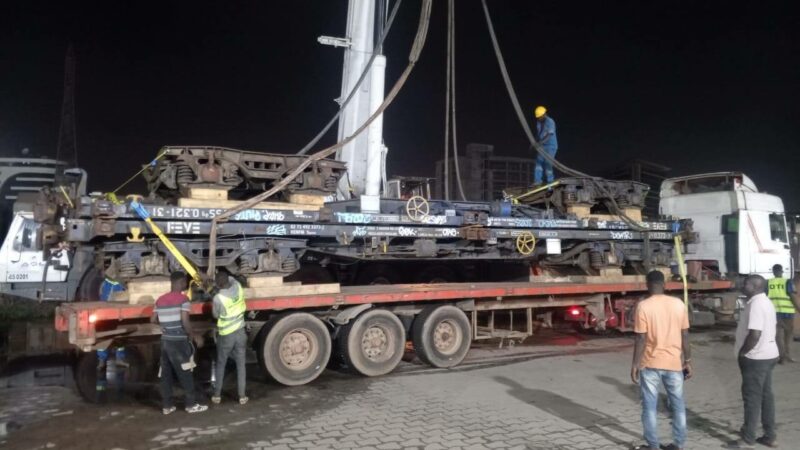
Conducted with a locomotive designed for heavy freight and passenger transport, the trials made it possible to assess the interaction between rolling stock and infrastructure: track, signalling systems, engineering structures, railway bridges and hydraulic installations. The results, deemed satisfactory by ANESRIF, confirm that the project complies with national and international technical standards.
For mining logistics in Algeria, this successful trial is decisive. It guarantees the line’s capacity to ensure the regular, secure and large-scale transport of iron ore from Gara Djebilet to industrial processing sites in Béchar, Tindouf and Nâama, as well as to the maritime gateway of Oran.
A strategic logistics corridor for Algeria’s supply chain
Beyond its technical performance, the Béchar–Tindouf–Gara Djebilet line is reshaping the supply chain in Algeria. It directly connects a landlocked mining area to industrial and port hubs, reducing logistics costs, transit times and dependence on road transport.
This integrated supply chain structure secures raw-material supply for the national steel industry, notably the Oran complex, while positioning Algeria more strongly on the international iron ore and steel market. At a time when logistics competitiveness has become a key factor in international trade in Africa, rail transport clearly emerges here as a strategic tool.
African records serving logistics in Algeria
The successful trial comes on infrastructure that already holds two African records: the first heavy-haul freight railway built across a desert, and the longest railway viaduct on the continent, with the 4.1-km Oued Daoura structure. Designed for axle loads of 32.5 tonnes, the line is sized to support the ramp-up of mining production, expected to reach 10 million tonnes of iron ore concentrates per year by 2033.
These technical choices enhance Algeria’s credibility as an emerging hub for logistics and transport in Africa, capable of developing logistics solutions tailored to the most demanding geographical and industrial constraints.
A strong signal for the future of mining logistics in Africa
The success of the Béchar–Tindouf–Gara Djebilet trials goes beyond the scope of a national project. It illustrates the ability of an African country to structure efficient mining logistics, integrated into an industrial vision and a long-term supply chain strategy.
At a time when many African states are seeking to better leverage their natural resources and strengthen their economic sovereignty, the Algerian experience offers a compelling case study. With this railway corridor soon to become operational, logistics in Algeria is moving to a new scale, confirming its central role in the country’s industrial and commercial transformation, while fully aligning with the broader dynamics of transport and supply chain development in Africa.
Image : Algeria Press Service