Côte d’Ivoire–Ghana: 150 km of Border Demarcated to Secure Cross-Border Trade
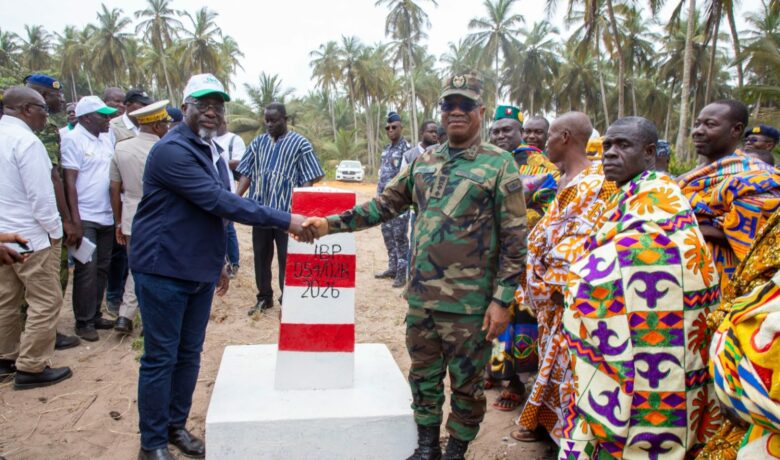
Côte d’Ivoire and Ghana: the two countries have completed the first phase of the physical demarcation of their shared border, covering 150 km. The operation is intended to clarify territorial boundaries while supporting the management of a key zone for cross-border trade in West Africa.
Côte d’Ivoire–Ghana border: first 150 km physically marked
Côte d’Ivoire and Ghana conducted a technical inspection on 22 September 2026 in Newtown, Ghana, focusing on BP 55, the zero boundary marker used as the reference point for the land and maritime border between the two countries.
The inspection brought together officials from the Côte d’Ivoire National Boundary Commission (CNFCI) and the Ghana Boundary Commission.
The operation comes ahead of an official ceremony scheduled for 24 September in Dibi, in southeastern Côte d’Ivoire. The event will formalize the handover of infrastructure built during the first phase, covering 150 km between boundary markers BP 55 and BP 48.
The demarcation concerns an area with significant movements of people, goods and commercial activities. Clearly identifying the boundary is expected to provide local administrations with a more precise territorial framework.
Côte d’Ivoire–Ghana border demarcation: what does it mean for trade flows?
For operators involved in Côte d’Ivoire–Ghana cross-border trade, the physical demarcation does not directly change customs procedures or border-crossing rules.
Its immediate operational value lies instead in reducing territorial ambiguities and providing clearer reference points for public authorities, local communities and land management.
The border area also has strong social and economic links. N’Zima communities live on both sides of the border and share language and cultural practices, supporting regular cross-border interactions.
Why it matters
- Trade flows: the Côte d’Ivoire–Ghana border is located along an important trade axis linking two major West African economies.
- Territorial management: clearly defined physical markers can facilitate coordination between government agencies and local authorities.
- Conflict prevention: the demarcation process is designed to reduce disputes linked to land ownership and the interpretation of the border line.
Second phase of Côte d’Ivoire–Ghana border demarcation planned for 2026
The process is being implemented within the framework of the African Union Border Programme and the Niamey Convention on Cross-Border Cooperation.
Since the establishment of the Joint Commission in August 2022 in Abidjan, technical teams from both countries have worked on the legal framework, cartographic analysis and construction of boundary infrastructure.
A second phase of border demarcation is expected to begin before the end of 2026, extending the work already completed along the first 150 km.
Regional perspective
The Côte d’Ivoire–Ghana border project comes as West African countries continue to strengthen border management while maintaining the flow of regional trade. For transport operators and shippers, the key issue will be ensuring that clearer territorial controls do not create additional delays or administrative bottlenecks along existing trade routes.
The demarcation of the first 150 km represents a technical milestone in the management of the Côte d’Ivoire–Ghana border. Its logistical impact will depend largely on coordination between border authorities and the ability to maintain efficient cross-border trade flows.