Cameroon – Kribi Port, Rail, and Bauxite: A Public-Private Partnership to Relaunch the Edéa–Kribi–Lolabé–Campo Railway Project
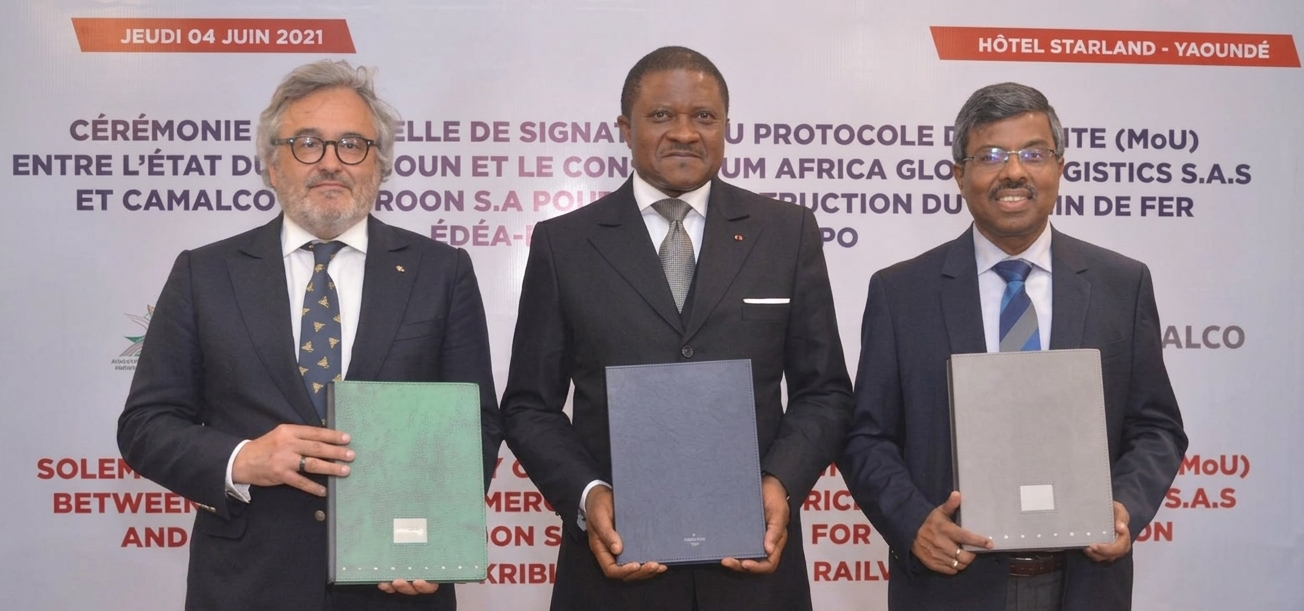
A Memorandum of Understanding (MoU) signed on June 4, 2026, in Yaoundé commits the State of Cameroon, logistics operator AGL, and mining company CAMALCO to structuring a public-private partnership around a long-awaited railway infrastructure. At stake: the evacuation of a 144-million-tonne bauxite deposit and providing the port of Kribi with a rail hinterland that matches its regional ambitions.
An Infrastructure at the Heart of Cameroon’s Development Strategy
Included among the priority projects of the National Development Strategy 2030 (SND30), the Edéa–Kribi–Lolabé–Campo line is set to play a decisive role in the country’s economic transformation.
The infrastructure aims to strengthen connections between production centers, the Kribi industrial-port complex, and the southern regions of Cameroon. Beyond improving the mobility of people and goods, the project is expected to help streamline trade flows, support industrialization, and foster the emergence of new growth hubs.
For the Cameroonian government, this project is part of a broader vision to modernize the national transport network and enhance the country’s economic competitiveness.
“The signing of this Memorandum of Understanding reflects the government’s determination to provide Cameroon with modern railway infrastructure adapted to its economic ambitions,” emphasized the Minister of Transport.
Minim Martap: 144 Million Tonnes of Bauxite with No Logistics Outlet
The economic trigger for the project is clearly identifiable. CAMALCO, the Cameroonian subsidiary of Australia’s Canyon Resources, is developing the Minim Martap bauxite deposit in the Adamawa region. Estimated reserves reach 144 million tonnes, with a production target of 10 million tonnes per year and a global investment of $446 million.
The problem is logistical before it is mining-related. Minim Martap is located more than 600 kilometers from the coast. Evacuating this volume by road is technically unsustainable and economically prohibitive. Without a railway infrastructure linking the deposit to the export port, the mining project remains on hold, regardless of the quality of the ore or the level of investment made on the extraction site.
The Edéa–Kribi–Lolabé–Campo line is therefore not a supporting project: it is a prerequisite for the commercial exploitation of Minim Martap. It is this direct causal link that gives the MoU its economic credibility—and explains CAMALCO’s commitment beyond the simple role of a user, with announced investments in rolling stock and logistics equipment.
Kribi: A Deepwater Port Waiting for its Rail Hinterland
The project is taking shape within a specific context: the deepwater port of Kribi is gaining momentum but suffers from a structural deficit: the lack of a rail connection to the interior of the country.
AGL already occupies a central position in the Kribi port ecosystem. The group is the operator and majority shareholder of Kribi Conteneurs Terminal (KCT) and holds a stake in KPIZ, the entity managing the port’s industrial-logistics zone. Its entry into this railway project follows a logic of vertical integration: connecting a container terminal and a logistics zone it already operates by rail, in order to expand their catchment area and improve their competitiveness.
For AGL, the challenge is to transform Kribi into a true multimodal hub—rather than managing an isolated port that is well-equipped but insufficiently connected to freight flows coming from the interior of the continent.
From the MoU to the reality of the construction site: the challenges that remain to be faced
A memorandum of understanding is not a construction contract. It defines a framework for cooperation and launches preliminary studies without committing to a firm schedule or definitive financing. The essential elements remain to be built: updating feasibility studies, financial engineering structuring, risk allocation between public and private actors, and the operational tariff model.
It is precisely on these points that the project’s viability will be decided. Major African rail corridors structurally suffer from a lack of bankability—high construction costs, long return on investment periods, and traffic risks that are difficult to cover. However, the presence of CAMALCO with a guaranteed volume of ore significantly improves visibility on future revenues, which is a significant asset for attracting institutional funders or infrastructure funds.
It remains to be seen whether the structuring will successfully mobilize long-term private capital, or if the Cameroonian State will have to bear a significant share of the construction and operational risk. The coming months, dedicated to updating the studies, will be decisive in assessing a realistic timeline for breaking ground.
Regional Perspective: A Missing Link in Central African Corridors
On a regional scale, this line fits into the broader issue of landlocked-clearing corridors in Central Africa. Cameroon is a primary transit country for several landlocked states. Kribi was sized to absorb a portion of this traffic, but without an efficient rail backbone to the interior, the port’s capacity gains remain underutilized.
Under the African Continental Free Trade Area (AfCFTA), reducing logistics costs is a structural condition to make intra-African trade competitive. A high-performance rail-port corridor between production zones and the export point constitutes a direct lever on these costs—provided that infrastructure access tariffs are calibrated accordingly and do not recreate barriers where the project intends to remove them.
If successful, the Edéa–Kribi–Lolabé–Campo line would position Kribi as a major logistics hub on the Atlantic coast of Central Africa, capable of seriously competing with other ports in the region for transit flows—and capturing a growing share of the region’s mining exports.