MOROCCO: 3RD INTERNATIONAL LOGISTICS CONGRESS PUTS SUSTAINABILITY AND OPERATIONAL EFFICIENCY AT THE CENTRE OF DISCUSSIONS
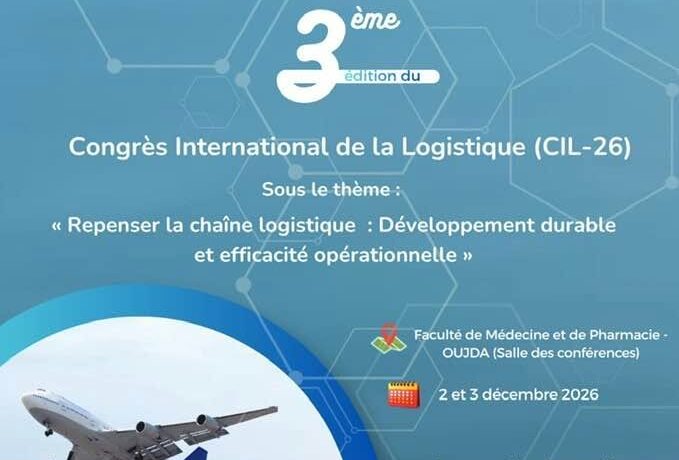
On December 2 and 3, 2026, the National School of Business and Management (ENCG) in Oujda will bring together researchers, experts and industry professionals to discuss the future of supply chains amid economic, technological and environmental challenges.
Against a backdrop of disruptions in international trade, digital transformation and growing pressure for ecological transition, logistics is increasingly becoming a strategic driver of competitiveness and economic development. These challenges will be at the centre of the 3rd International Logistics Congress (CIL-26), scheduled for December 2–3, 2026, and organised by the National School of Business and Management (ENCG) in Oujda, Morocco.
Held under the theme “Rethinking the Supply Chain: Sustainable Development and Operational Efficiency,” the event aims to bring together researchers, academics, experts, industry professionals and decision-makers to examine the changes reshaping supply chains and identify solutions suited to today’s requirements.
Rethinking Supply Chains in Response to Global Crises
Once viewed primarily as a set of operations focused on transporting goods, managing inventories and controlling costs, the supply chain now plays a central role in business performance, territorial competitiveness and the continuity of economic exchanges.
Successive crises have fundamentally changed traditional approaches to logistics. The COVID-19 pandemic, geopolitical tensions, the war in Ukraine, maritime transport disruptions, rising energy costs, inflation and the effects of climate change have exposed the vulnerabilities of many supply chains.
In an environment where economies are highly interconnected, a disruption in one location can quickly affect international trade, cause delivery delays, increase costs and threaten product availability.
In response to these vulnerabilities, companies and institutions are being urged to move beyond logistics models based exclusively on speed and cost reduction. The priority is now to build supply chains that are more resilient, flexible and transparent, with the capacity to adapt to uncertainty.
This requires better risk anticipation, diversified sourcing strategies, stronger coordination between stakeholders and more intelligent flow management.
Sustainability: A Key Requirement for the Logistics of Tomorrow
Beyond economic performance, sustainability has become one of the major challenges shaping the transformation of logistics.
Reducing carbon emissions, controlling energy consumption, limiting waste, optimising resources, adopting renewable energy and integrating circular economy principles are increasingly essential criteria for assessing supply chain performance.
CIL-26 aims to contribute to discussions on logistics models that combine operational efficiency with environmental responsibility.
The objective is to demonstrate that sustainability is not simply an additional constraint for businesses, but a necessary condition for long-term operational viability and the development of more responsible supply chains.
Digital Transformation as a Driver of Operational Efficiency
Alongside environmental requirements, technological innovation is opening up new opportunities to improve logistics management and operational performance.
Artificial intelligence, the Internet of Things (IoT), blockchain, digital twins, integrated information systems and predictive analytics offer significant opportunities in traceability, data reliability, disruption forecasting and route optimisation.
These technologies can also improve coordination between the various stakeholders across the supply chain and strengthen decision-making processes.
Through scientific and professional discussions, the congress aims to identify innovations capable of supporting the transition towards more connected, responsive supply chains that are better adapted to changing economic requirements.
Morocco: Strengthening Its Position as a Regional Logistics Hub
In Morocco, these challenges are particularly significant. Thanks to its strategic geographical position between Europe, Africa and the Middle East, the Kingdom has major advantages in strengthening its role as a regional and international logistics hub.
The development of port, industrial and logistics infrastructure, the expansion of business zones, and national priorities relating to competitiveness, energy transition and sustainable development all demonstrate the importance attached to logistics in the country’s economic growth and integration prospects.
However, several challenges remain, including improving operational efficiency, modernising information systems, ensuring data reliability, reducing transport-related emissions and developing professional skills.
The adoption of sustainable logistics practices within companies is also a major requirement for supporting this transformation.
In this context, CIL-26 intends to highlight national initiatives aimed at modernising the sector, particularly Morocco’s port strategy, the digitalisation of customs procedures and the development of logistics infrastructure.
A Scientific Platform for Building Tomorrow’s Supply Chains
Beyond knowledge sharing, the 3rd International Logistics Congress aims to serve as a platform for dialogue between researchers, economic stakeholders and public institutions.
Discussions will focus on major supply chain transformations, technological innovations, management approaches and public policies capable of strengthening the sustainability and efficiency of logistics operations.
The congress is particularly aimed at researchers, academics, doctoral students, logistics and supply chain professionals, as well as institutional stakeholders whose work contributes to a better understanding of the sector’s contemporary challenges.
The proposed scientific themes will explore different dimensions of logistics transformation, encouraging knowledge sharing, the comparison of theoretical and empirical approaches, and the development of new perspectives on models suited to economic, technological, environmental and territorial changes.
Objectives Focused on Innovation and Cooperation
Through this event, the National School of Business and Management in Oujda aims to encourage exchanges between researchers, academics, experts and industry professionals while identifying emerging trends and innovations transforming logistics practices.
The event also seeks to promote collective reflection on regional logistics models that are more sustainable, efficient and better suited to the requirements of the ecological transition and digital transformation.
By bringing together different stakeholders around these challenges, CIL-26 aims to contribute to a better understanding of the changes affecting logistics and the development of practical solutions to support businesses and territories.
On December 2 and 3, discussions in Oujda will therefore provide an opportunity to rethink supply chains as a whole, balancing resilience, innovation, operational efficiency and environmental responsibility.
The congress places logistics at the centre of discussions on economic competitiveness and sustainable development, both in Morocco and at regional and international levels.
For more information, visit: https://www.cil26.amlt.net/