Aviation and Pharmaceutical Supply Chains: The AfDB Launches Two Platforms to Address Africa’s Structural Deficits
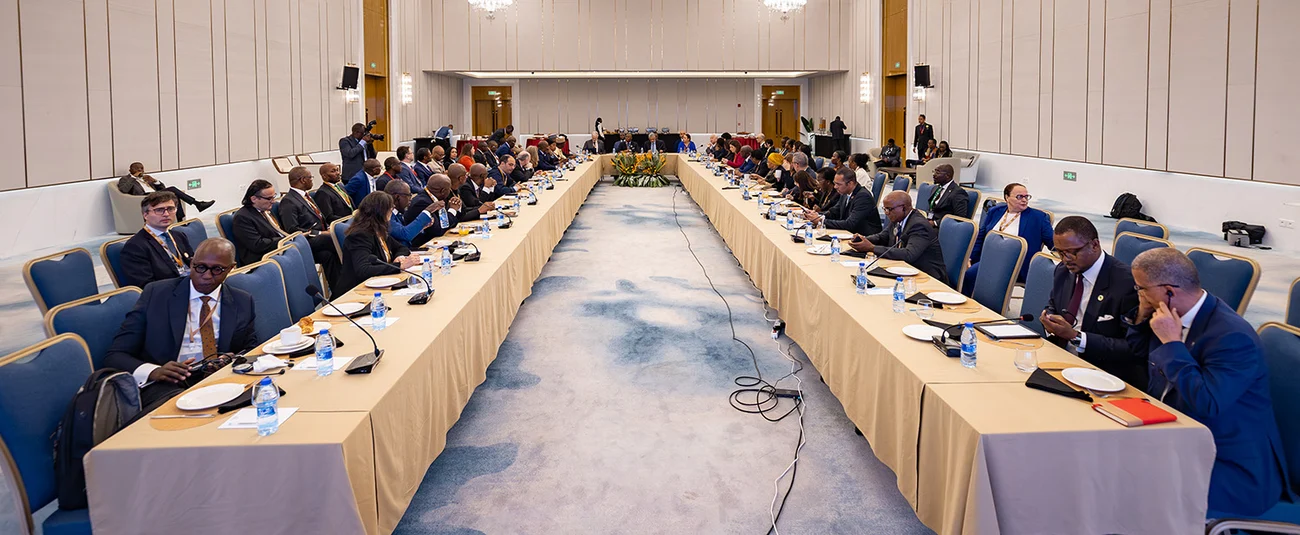
At its 2026 Annual Meetings in Brazzaville, the African Development Bank Group formalized two structured financing mechanisms designed to remove systemic bottlenecks in aviation and pharmaceutical supply chains. With $7 billion targeted at air transport over five years and Japan’s $10 million contribution already confirmed, the institution aims to position these platforms as drivers of regional economic integration — not merely sectoral programmes.
A Shared Financial Architecture for Two Structurally Deficient Sectors
On 28 May 2026, on the sidelines of the Annual Meetings held in the Congolese capital, the AfDB presented two complementary initiatives to an audience of governors, institutional investors, philanthropic foundations and private sector representatives: the Integrated Aviation Transformation Programme for Africa (IATP) and the African Medical and Equipment Facility (AMEF).
Beyond their sectoral scope, both instruments share the same financial logic: aggregate public and private partners around a common platform, pool risks, and create conditions for capital mobilisation at a scale that project-by-project financing cannot achieve. This paradigm shift — from isolated project financing to integrated platforms — reflects a broader evolution in the expected role of multilateral development banks in a post-Covid, increasingly fragmented geopolitical environment.
Aviation: An Under-Exploited Market with a Quantified Connectivity Deficit
The data presented during the session illustrates the scale of accumulated delay. Only 19% of air routes across the continent are operated by African carriers — whether regional or national. The cost of this connectivity gap is estimated at between $50 and $100 billion per year, a range that encompasses direct losses for operators as well as knock-on effects on trade, tourism and regional supply chains.
The IATP targets three priorities: fleet modernisation, strengthening of airport and logistics infrastructure, and integration of the African air transport market. The stated objective is to mobilise $7 billion over five years, bringing together African states, the African Union, development partners, private investors, aircraft manufacturers and leasing companies.
Nigeria has already signed the programme’s first National Pact, as announced by Federal Minister of Aviation Festus Keyamo — a notable political signal for a market that ranks among the continent’s largest by domestic traffic volume.
Leasing: The Central Bottleneck in African Fleet Financing
One of the most frequently cited structural obstacles in African aviation is access to fleet financing. Airlines on the continent face significantly higher capital costs than their Asian or Middle Eastern counterparts, due to risk profiles that international lenders and leasing companies consider unfavourable.
This is precisely where Japan’s $10 million contribution carries operational significance. Directed toward the IATP’s Risk-Sharing Facility, this envelope is designed to absorb part of the risk perceived by private financiers, thereby lowering the cost of leasing access for African operators. Senegal’s Minister of Economy, Abdourahmane Sarr, explicitly identified the AfDB’s triple-A credit rating as a catalytic asset within this risk-reduction mechanism — a dynamic already demonstrated, for instance, in the mobilisation of financing for Tanzania’s standard gauge railway project.
Medicines and Vaccines: An Import Dependency That Undermines Health Systems
On the pharmaceutical side, the figures are equally stark. Africa produces less than 1% of the medicines it consumes and approximately 0.5% of its vaccines. Only 40% of essential medicines are available on time, and access delays can stretch from three to nine months — timelines incompatible with an effective response to health emergencies.
The AMEF aims to structure more stable procurement mechanisms: buyer coordination, price transparency, pooled orders and secured logistics networks. The link with aviation is far from incidental: air freight is the primary vector for the rapid delivery of pharmaceutical products, cold-chain vaccines and high-value medical equipment. The two platforms are therefore functionally interdependent.
Implications for States, Airlines and Investors
For African governments, the stakes are twofold: benefiting from improved connectivity to support implementation of the African Continental Free Trade Area (AfCFTA), while reducing vulnerability on strategic supply chains. Cameroon and Guinea both expressed support for both initiatives, notably highlighting the risk of fragmentation if efforts are not pooled at continental scale.
For airlines, the IATP platform represents an opportunity to access fleet financing on improved terms — provided that the risk-sharing mechanisms are genuinely operational and accessible to mid-sized operators, not only to major national carriers.
For institutional investors and specialist funds, the AfDB’s positioning as a risk aggregator opens the door to investment in African aviation assets that have until now been perceived as too risky or too fragmented to justify direct exposure.
Outlook: Between Structural Ambition and Execution Challenges
The intellectual coherence of the platform approach is real. The question that systematically arises with this type of multilateral initiative, however, is execution capacity: platform governance, speed of first-financing deployment, and the effective alignment of private partners beyond statements of intent.
The first test will be the IATP’s launch phase. With the Nigerian Pact signed and the Japanese contribution committed, the priority will now be to demonstrate that the risk-sharing mechanism can tangibly alter fleet financing conditions in the market. If that signal proves convincing, further states may move quickly to join the coalition.
Over the medium term, the question of consolidating Africa’s aviation sector remains open. The emergence of regional carriers of sufficient scale — capable of competing with Gulf and Asian operators on intercontinental African routes — requires regulatory harmonisation, effective market liberalisation and a coherent industrial policy on leasing and MRO. The IATP can serve as a catalyst for that process. It cannot be a substitute for it.