

India-Namibia Trade Reaches $608 Million as Digital Payments and Mining Cooperation Expand
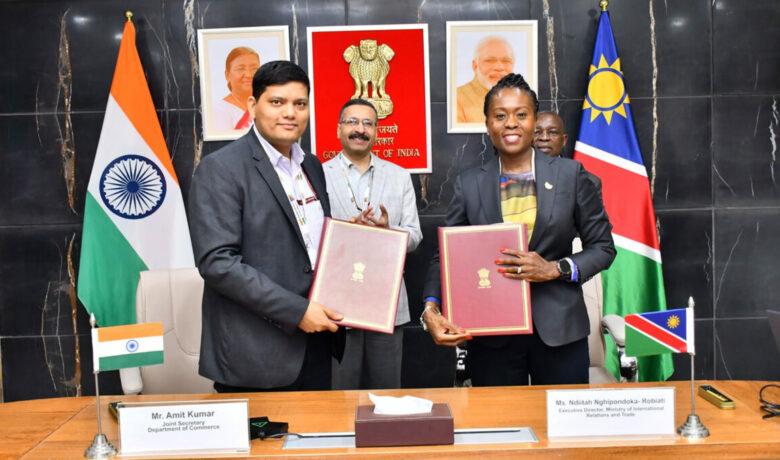
Namibia and India are expanding bilateral economic cooperation, with trade reaching $608.12 million in 2025-2026. The partnership is also extending into digital payments, mining, skills development and trade facilitation, creating new channels for cross-border commercial flows.
India-Namibia Trade: $608 Million in 2025-2026
Trade & AfCFTA: Namibia and India are strengthening their commercial relationship as bilateral trade continues to grow. According to the latest figures, trade reached $608.12 million during the 2025-2026 financial year, up from $568.40 million in 2024-2025.
India’s exports to Namibia accounted for $479.43 million, while imports from Namibia reached $128.69 million.
The figures underline the growing importance of the bilateral trade corridor. For Namibian businesses, the relationship provides access to Indian suppliers and markets. For Indian companies, Namibia offers a gateway into Southern Africa and the wider SACU market.
India and the Southern African Customs Union (SACU), coordinated by Namibia, have also finalized the terms of reference for a Preferential Trade Agreement (PTA).
Digital Payments Could Support Cross-Border Trade
Payment infrastructure is becoming another component of the India-Namibia trade relationship.
NPCI International Payments Limited (NIPL) and the Bank of Namibia have signed a technology licensing agreement covering India’s Unified Payments Interface (UPI) technology.
The agreement creates a framework for bilateral cooperation on digital payments. Operationally, stronger payment connectivity can facilitate transaction processing for businesses and consumers involved in cross-border commerce.
For logistics operators, this matters because payment settlement is linked to the completion of commercial transactions, including purchases, imports and exports. Faster and more accessible payment channels can reduce friction in trade processes, although the agreement itself does not establish specific transaction volumes or cost reductions.
Mining and Supply Chain Cooperation
Mining and minerals are another area of cooperation. The third meeting of the India-Namibia Joint Working Group on Mining and Mineral Resources was held on 30 September 2025.
The sector is relevant to supply chains because Namibia is a mineral-producing economy, while India has significant industrial demand for raw materials. Increased cooperation could therefore influence future commodity flows, sourcing arrangements and transport requirements between Southern Africa and India.
Beyond trade, India has also supported Namibia through technical training and infrastructure projects. A communications and information technology laboratory supported by India was inaugurated at the Namibian Defence Force Signal School in Okahandja on 23 March 2026.
Why It Matters
- Trade flows: Bilateral trade increased from $568.40 million to $608.12 million in one financial year.
- Payment infrastructure: UPI technology cooperation adds a digital layer to the India-Namibia commercial corridor.
- Supply chains: Mining cooperation could support future flows of minerals and industrial inputs between Southern Africa and India.
A Southern African Gateway for Indian Trade
Namibia’s position within SACU gives the bilateral relationship a regional dimension. Trade infrastructure, customs procedures, payment systems and transport connections will determine how efficiently goods can move beyond the two countries.
For Namibia, stronger commercial links with India can diversify external markets and suppliers. For Indian companies, the country can serve as an entry point into Southern African trade networks.
The India-Namibia trade corridor is expanding beyond traditional goods exchange. With $608.12 million in bilateral trade, cooperation on digital payments, mining and the SACU trade framework could progressively strengthen the commercial and supply chain links between India and Southern Africa.